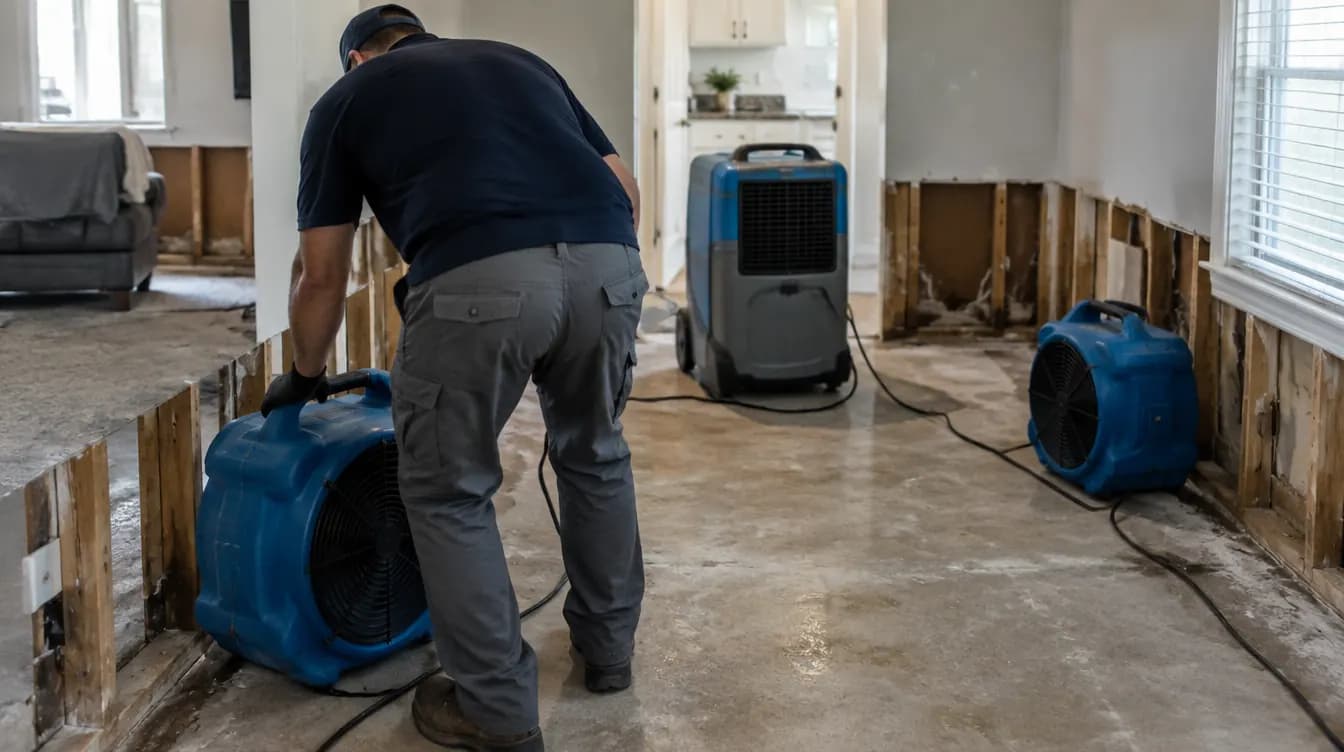

The first company to answer wins
A homeowner standing in water keeps calling until someone picks up. A voicemail at 2 a.m. hands the job to the next listing.

Restoration calls come in at the worst hour of a homeowner’s year. We make sure someone answers fast, explain the insurance side plainly, and keep the job with you from mitigation through rebuild.
A homeowner standing in water keeps calling until someone picks up. A voicemail at 2 a.m. hands the job to the next listing.
Carriers, adjusters, and preferred-vendor programs all shape who does the work. Many homeowners don’t realize they usually get a say in who that is.
Plenty of homeowners let one company dry the house and another put it back together. The rebuild is usually the bigger part of the job.
You can’t build demand ahead of a burst pipe. You can only be the name homeowners find, and trust, when it happens.
Four parts. Each one multiplies the others. Here’s where they break in your trade, and what we install.
Search ads alone, so your name means nothing to anyone until the moment of loss.
Search ads for active emergencies on larger plans, plus video of your crews on real losses so homeowners and local insurance agents know your name before they need it.
A generic homepage that answers none of the questions a panicked homeowner has.
Pages for water, fire, and mold, each with what to do in the first hour, how the insurance side usually works, and a one-tap call button.
Emergency calls go to voicemail after hours, and web forms wait until morning.
Instant text-back, after-hours call routing to your on-call tech, and follow-up after mitigation that sets up the rebuild conversation.
Mitigation invoices and rebuild contracts live in separate places, so nobody sees what one lead was worth.
Tracking from first call through mitigation and rebuild, with insured and out-of-pocket jobs split, so spend is judged on full job value.
Your tech explains what to do right after a leak or a fire, on camera, before anyone needs it. It’s useful, and it gets remembered.
Explain plainly how your team works alongside the insurance company, for homeowners who assume the carrier picks the contractor.
Follow one water loss from fans and moisture readings to finished cabinets, so homeowners see one team handle both halves.
A calm look at testing and remediation, aimed at homeowners who found something and don’t know how worried to be.
So the homeowner on your calendar already fits your jobs, your area, and your price range.
Example numbers for a restoration business. Change them to yours.
Each lead is worth (revenue): $7,500
$25,000 project, 35% margin, 60% of leads booked, 50% of estimates closed.
See what we’d build for these numbersStarts with example numbers. Change them to yours. Arithmetic only, not a promise of results.
Local playbooks for restoration contractors: what’s different about each market, and what we’d run there.
Not for the emergency itself. People in the middle of a loss search, so search ads and your Google Business Profile carry that. Video works for mold, rebuilds, and being a name homeowners recognize.
No. Coverage depends on the policy and the claim. The ads and pages explain how your team works with insurance companies, without promising what a carrier will pay.
That’s what the follow-up is for. After the dry-out, homeowners get clear next steps on the rebuild from your team instead of hunting for another contractor.
Most gaps are on the web side: forms that sit overnight, no text-back, and no record of where the call came from. We close those and tie each job to its source.
Seven questions. Two minutes. See the one part of your engine holding your projects back.
Show me where I’m losing jobsFree 2-minute assessment · No pitch, no obligationAvg response time 2.5 minutes